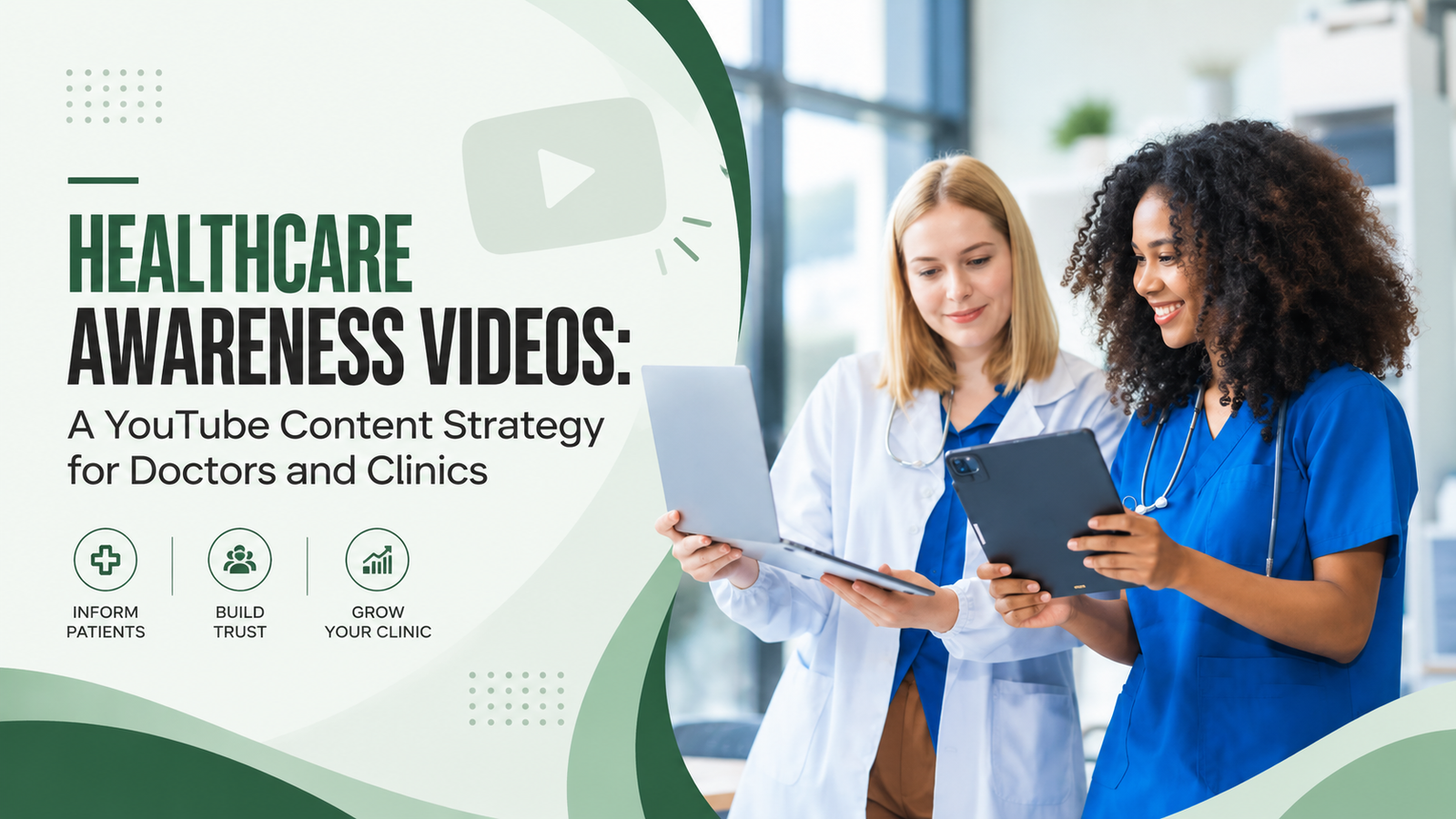
Healthcare Awareness Videos: A YouTube Content Strategy for Doctors and Clinics
The most sustainable healthcare YouTube content is not procedure marketing. It is not a clinic promotion. It is not even patient testimonials, valuable as those are. The most sustainable content a doctor can produce on YouTube is genuine healthcare awareness — educational material that serves the public's real need to understand their health, with no expectation of immediate commercial return.
This kind of content — clear, accurate, accessible explanations of health conditions, risk factors, preventive measures, and treatment principles — is what builds the largest audiences on healthcare YouTube channels. It is what earns the algorithmic consistency that makes a channel grow steadily rather than in bursts. And it is what establishes a doctor as an authority not just in their patient base, but in the broader digital public that shapes long-term professional reputation.
For clinics across South Delhi and across India, healthcare awareness video content is also one of the most differentiated strategies available — because most clinics are not doing it. Most clinic YouTube channels are filled with before-and-after images, promotional service announcements, and procedure clips. A channel that consistently produces genuinely useful, accurately researched healthcare awareness content stands apart immediately.
What You'll Learn
- What healthcare awareness videos are and why they form the backbone of sustainable YouTube growth.
- The critical distinction between educational awareness content and direct promotional marketing.
- The 5 essential categories of awareness content that engage and retain healthcare audiences.
- 30 curated video ideas across dermatology, hair/scalp, aesthetic medicine, and dentistry.
- How consistent educational publishing builds long-term doctor authority and high-intent local trust in South Delhi.
- Practical standards for medical sourcing, publishing frequency, and multi-platform content repurposing.
What Are Healthcare Awareness Videos?
Healthcare awareness videos are educational YouTube content that explains health topics of broad public relevance — conditions, risk factors, prevention, lifestyle factors, and the general principles of treatment — without being tied to a specific procedure the clinic offers or a specific patient the clinic wants to attract.
A dermatologist who produces a video explaining the connection between diet and skin health is creating healthcare awareness content. A hair transplant surgeon who explains the difference between natural hair loss patterns and alopecia is creating healthcare awareness content. An aesthetic doctor who explains what happens to facial structure with age, independent of any injectable treatment, is creating healthcare awareness content.
What distinguishes awareness content from other healthcare video types is that its primary purpose is to educate — not to market, not to convert, not to demonstrate what the clinic can do. The commercial benefit comes indirectly, over time, as the doctor's consistent educational presence builds the kind of authority and trust that attracts patients who are self-selecting based on expertise rather than responding to an advertisement.
Awareness Content vs Promotional Content: The Critical Distinction
The most important strategic decision in healthcare YouTube content is understanding the difference between content that educates and content that promotes — and deliberately producing more of the former.
Promotional content talks about what the clinic does. Awareness content educates the public about what they should know. Promotional content brings immediate commercial intent. Awareness content builds long-term authority. Both have a role, but the ratio in most clinic YouTube channels is badly skewed toward promotion — which is why those channels grow slowly, attract lower-quality viewership, and fail to build the kind of doctor authority that drives premium consultation enquiries.
"The doctor who teaches on YouTube builds an audience that comes to them because of what they know. The doctor who only promotes builds a feed that patients scroll past."
— Prince KhatanaThe ratio that works: approximately 60 to 70 percent of YouTube content should be awareness and educational, 20 to 25 percent should be procedure-specific and clinical, and 10 to 15 percent should include commercial elements such as service explanations and consultation invitations. Most clinics currently operate at roughly the inverse of this ratio.
Types of Healthcare Awareness Videos
Effective awareness content spans several distinct formats, each serving a specific stage of viewer interest and public health need:
- Condition explainers: What is this condition? What causes it? Who is at risk? What does progression look like without intervention? These videos serve patients in the earliest stage of health awareness — often before they have even identified their concern as something that warrants medical attention.
- Myth-busting content: Healthcare misinformation is widespread and actively harmful. A doctor who consistently corrects common misconceptions in their specialty — with clarity, evidence, and without condescension — builds a reputation for intellectual honesty that is extremely difficult to compete with.
- Prevention and lifestyle: What lifestyle factors influence the conditions a doctor treats? What can patients do to reduce their risk or slow progression? This category reaches the broadest possible audience because it serves people who do not yet have a problem as well as those who do.
- Seasonal and timely awareness: Hair loss patterns in monsoon season, skin care adjustments for Delhi's extreme temperature shifts, sun protection in Indian climate conditions — locally and seasonally relevant awareness content performs exceptionally well in search because it serves a specific current need.
- Signs and symptoms: When should a patient seek professional advice? What signs suggest a condition that warrants attention versus one that can be monitored at home? This category gives clinics direct access to patients at the precise moment they are deciding whether to book a consultation.
30 Healthcare Awareness Video Ideas by Specialty
To help clinics build a robust content calendar, here are 30 high-impact awareness video concepts broken down across core medical and aesthetic specialties:
Dermatology (10 Ideas)
- What causes dark circles (and what actually works vs what doesn't).
- The real reason sun damage is cumulative across decades.
- Three skin conditions commonly mistaken for each other.
- Why Indian skin responds differently to certain active ingredients.
- The dermatology conditions most commonly misdiagnosed at home.
- Adult acne vs teenage acne: Understanding the internal and external triggers.
- What your skin tells you about your internal health and nutrition.
- The biological science of skin ageing and collagen degradation.
- Why most over-the-counter skin products fail to deliver promised results.
- Common skincare ingredient interactions that can damage your skin barrier.
Hair & Scalp (10 Ideas)
- What causes hair loss in women vs men: The physiological differences.
- The stress-hair loss connection (Telogen Effluvium explained simply).
- Why hair loss treatments work for some patients and fail for others.
- Scalp health as the foundation of hair quality and density.
- Nutritional deficiencies and blood markers that directly affect hair growth.
- What normal hair shedding looks like vs problematic daily hair loss.
- Why hair loss often appears to worsen before medical treatments show results.
- The role of DHT (Dihydrotestosterone) in male pattern baldness.
- Seasonal hair shedding myths and biological realities in India.
- Hereditary hair loss — understanding your family risk factors early.
Aesthetic Medicine & Dentistry (10 Ideas)
- Why facial proportions matter more than individual features in aesthetic balance.
- What happens to facial volume, fat pads, and bone structure with age.
- How chronic sun exposure affects skin texture and elasticity over decades.
- The difference between preventive skin maintenance and corrective medical aesthetics.
- How to evaluate whether aesthetic advice is evidence-based or trend-driven.
- The biological connection between gum health and systemic cardiovascular disease.
- What causes tooth sensitivity and when it signals a deeper structural issue.
- Why teeth grinding (bruxism) is more medically serious than most realise.
- The long-term functional consequences of leaving missing teeth unreplaced.
- How to evaluate early dental and orthodontic care in children.
How Awareness Videos Build Long-Term Doctor Authority
Doctor authority on YouTube is built through two primary mechanisms: depth and consistency. Depth comes from content that goes beyond surface-level summaries and demonstrates genuine clinical expertise in the specific patterns, nuances, and clinical realities of a specialty. Consistency comes from a sustained publishing rhythm that accumulates a body of work over months and years.
Healthcare awareness content serves both mechanisms simultaneously. Each video adds to the library of demonstrated expertise. The cumulative body of content tells both YouTube's algorithm and prospective patients the same thing: this doctor knows this specialty thoroughly and communicates it clearly without commercial pressure.
The authority built through consistent awareness content is also more durable than the authority built through promotional content. A patient who discovers a clinic through an awareness video about a condition they have been managing for years arrives with a qualitatively different level of trust than a patient who saw a promotional video. They have been educated by this doctor. The relationship, however asymmetrical, has already begun.
Healthcare Awareness Marketing in South Delhi
South Delhi — encompassing healthcare hubs including Saket, Vasant Kunj, Malviya Nagar, Hauz Khas, and Greater Kailash — serves a patient population with exceptionally high healthcare literacy and active digital research habits. Patients in these neighborhoods engage substantively with educational health content and are discerning evaluators of its quality, tone, and clinical credibility.
For specialist clinics in South Delhi, healthcare awareness video content is one of the most effective ways to build the kind of sustained local authority that transcends advertising competition. A dermatologist, hair specialist, or plastic surgeon whose YouTube channel has become the go-to educational resource for skin and hair health in South Delhi occupies a defensive and offensive competitive position that no advertising budget can quickly displace.
How Dr. Graphical™ Develops Healthcare Awareness Content
Dr. Graphical™'s approach to healthcare awareness video content begins with a specialty-specific content architecture: a structured map of the awareness topics most relevant to the clinic's specialty, the patient concerns they address, the search queries they serve, and the relationship between individual videos in building cumulative topical authority.
Content is produced in series wherever possible — a related group of videos that collectively cover a topic comprehensively — rather than as isolated individual pieces. This series structure serves both the patient, who benefits from a coherent educational journey, and the YouTube algorithm, which rewards channels that demonstrate consistent topical depth.
Frequently Asked Questions About Healthcare Awareness Videos
Will awareness content actually bring patients to my clinic?
Not immediately, and not as directly as promotional content. Awareness content builds authority and familiarity over time, which translates into consultation enquiries through an indirect but durable pathway. A patient who has been watching a doctor's educational content for three months before developing a concerning symptom does not search for a clinic — they go to the doctor they already trust. That is the commercial value of awareness content: it creates pre-formed relationships with the patients who will need the clinic's services in the future.
How do I prevent awareness content from educating patients out of needing a consultation?
Effective healthcare awareness content does not replace the need for professional assessment — it clarifies when that assessment is necessary. A video that explains the difference between normal hair shedding and problematic hair loss does not prevent the patient with problematic hair loss from booking a consultation. It helps them identify their situation and understand why a professional assessment is the appropriate next step. Educational content that serves patients honestly increases consultation quality, not decreases consultation volume.
Should awareness videos cite medical sources?
Yes, where relevant to the specific claims being made. On-screen or description-linked citations from recognised medical sources — peer-reviewed research, national health guidelines, established medical organisations — significantly strengthen the credibility of awareness content. They also protect the doctor professionally by grounding clinical statements in evidence rather than individual opinion. Dr. Graphical™ incorporates source citation into the awareness content production workflow as standard.
How frequently should awareness videos be published?
Consistency matters more than frequency. One well-researched, clearly produced awareness video per week is significantly more effective than a burst of ten videos followed by a month of inactivity. The awareness content strategy should be designed around what is genuinely sustainable for the doctor's schedule — whether that is weekly, biweekly, or monthly — rather than around an aspirational volume that cannot be maintained.
Can awareness content be repurposed for other channels?
Yes — awareness content is among the most repurposable category of healthcare video. The same educational information can be adapted as a YouTube Short, condensed into a LinkedIn post, expanded into a blog article with the video embedded, used as a basis for a Google Business Profile update, and referenced in patient education materials within the clinic. Dr. Graphical™ designs awareness content with multi-platform repurposing built into the production brief.
About this article: This guide was produced by the Dr. Graphical™ content team based on healthcare video marketing experience, YouTube platform best practices, and publicly available industry research. Healthcare-related claims in any clinic's content should be reviewed by a qualified medical professional before publication.