NMC Guidelines 2026 for Doctors in India: A Simple Guide to Medical Advertising and Social Media
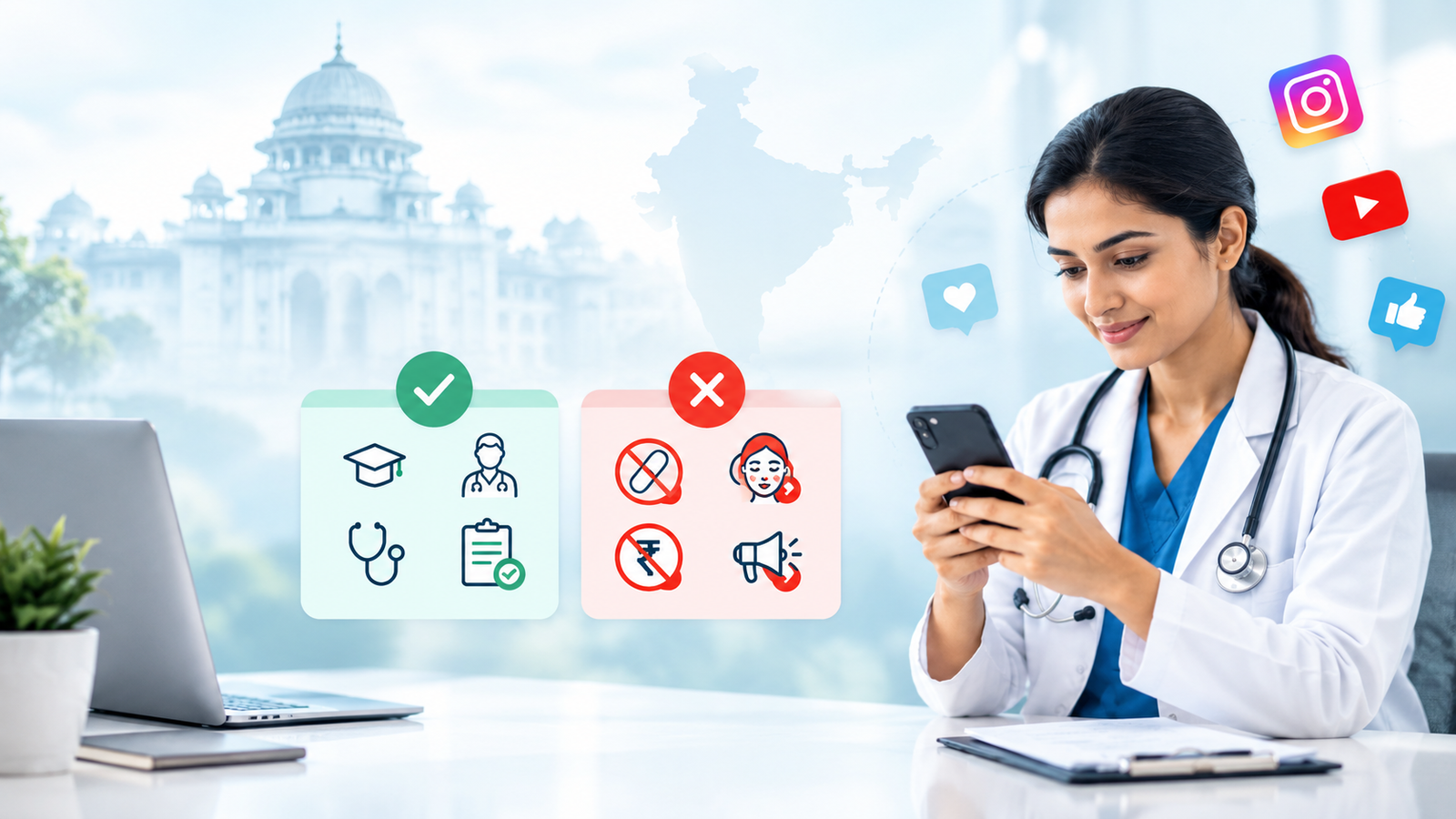
On 6 October 2026, the National Medical Commission (NMC) issued a public notice with new Guidelines on Ethical Advertising and Public Communication. They apply to hospitals, medical institutions and Registered Medical Practitioners (RMPs). The notice says they come into force with immediate effect.
If you are a doctor or run a clinic, this matters to you. These rules touch your website, Instagram, YouTube, Google profile, podcast appearances, patient stories and even AI-made content.
I run Dr. Graphical, a healthcare communication company, so I have read the document line by line and want to explain it in simple words. I am not a lawyer or a medical ethics expert. This is an educational summary, not legal advice. The original NMC document always comes first. You can read it here: NMC Guidelines on Ethical Advertising and Public Communication (notice dated 06.10.2026). Clause numbers in this guide point to that document.
What You'll Learn
- What the 2026 NMC guidelines are, who they cover and why they were issued.
- The key rules on claims, testimonials, before-and-after photos, offers, reviews, AI and patient privacy.
- What it means for your website and social media, platform by platform.
- What doctors can still communicate, and what hospitals can say.
- A practical compliance checklist and a quick screening table.
- The consequences of a violation, and the appeal route.
What Are the NMC Guidelines for Doctors in 2026?
The NMC's Ethics and Medical Registration Board released the guidelines through a public notice (No. R-13014/01/2024-Ethics) dated 6 October 2026. They cover how doctors and hospitals talk to the public: ads, social media, websites, podcasts, influencer posts and AI-generated promotion.
Why were the guidelines issued?
The notice says they were framed in view of Writ Petition (Civil) No. 1160/2023 in the Supreme Court and the 2002 Indian Medical Council ethics regulations. The stated aims are simple:
- Preserve the dignity of the medical profession
- Prevent commercialisation of healthcare
- Protect patients from misleading medical claims
- Keep healthcare communication informational, ethical and evidence-based
- Bring hospital advertising closer to the standards that apply to individual doctors
The guidelines also say that nothing in them permits anything that other laws or regulations already prohibit (Clause 2.2).
Who should read this guide?
- Individual doctors, including dermatologists, hair transplant surgeons, dentists, IVF specialists and cosmetic physicians
- Clinic and hospital owners
- Marketing managers, social media managers and anyone who posts on behalf of a doctor
- Agencies and creators who work with healthcare brands
One thing worth knowing: the person who posts is often not the doctor. But the rules say that using an agency, influencer or other middleman does not remove responsibility for content the doctor or institution authorised, commissioned, sponsored, adopted or knowingly permitted (Clause 4.4). So the doctor should know what goes out in their name.
What is the scope of the guidelines?
The definition of "advertisement" is wide. It covers any communication in any medium that directly or indirectly promotes the services, reputation, skills, qualifications, achievements or facilities of an RMP or institution. Digital, social media, sponsored, influencer-led, search-engine and AI-assisted communication is treated as advertising when it has a promotional character (Clause 3.2).
The listed mediums include social media, websites and blogs, WhatsApp and Telegram, podcasts, influencer marketing, sponsored posts, public interviews and news articles intended for promotion (Clause 3.5).
There is also an important exception. Sharing information with the public in the normal course, without being promotional and without any intent for commercial benefit, is outside the definition of advertisement (Explanation I to Clause 3.2).
Two more things to keep in mind:
- For doctors, the guidelines are read with the 2002 Ethics Regulations and the NMC Act, 2019. If there is a conflict, the statute and regulations win.
- For hospitals, they are read with the Clinical Establishments Act or the relevant State Act. If there is a conflict, that Act wins (Clauses 4.2 and 4.3).
"A doctor doesn't need to stop communicating. A doctor needs to know where information ends and promotion begins."
— Prince KhatanaKey NMC Rules Every Doctor Should Understand
Each rule below follows the same format: what the rule says, what it means in practice, an example to review, what to do next, and the source. The examples are things to review. I am not saying any specific post is legal or illegal. That depends on the exact wording, purpose and circumstances.
1. Misleading medical claims and exaggerated promises
An RMP shall not advertise personal achievements, success rates or number of patients treated using assertions such as "Guaranteed cures", "Best doctors", "No.1 Specialist", "100% success", "painless treatment" or "Miracle treatment", or any other unverifiable or exaggerated claim. Statements that create unrealistic expectations, hide risks or promote unproven therapies are also covered.
Superiority words like "best", "leading", "top", "most trusted" or "unmatched" are restricted for both doctors and institutions unless the claim is objectively verifiable and based on a transparent, independently checkable method. Any ranking or award used must be independently verifiable, with the awarding body, methodology and date disclosed where needed.
Words that sound like a promise or a ranking are risky. Describing a treatment honestly, with its limits, is the safer direction.
"100% guaranteed hair transplant results." "India's No. 1 dermatologist." "Permanent cure for every patient."
Read through your website, bio, Google profile and old posts for promise words and ranking words. Ask whether each claim can be independently verified. If not, it needs a closer look.
Clauses 8.1(iii), (vi) and (ix)
2. Patient testimonials and endorsements
The guidelines say an RMP shall not request or share patient testimonials, recommendations, endorsements or reviews for professional promotion on social media (Explanation V to Clause 3.2). An RMP shall also not permit the use of their name, image, voice, testimonial or endorsement to promote services or products. A doctor cannot use a celebrity, influencer, patient, employee or other third party to do through prohibited testimonials what the doctor cannot do directly.
Patient consent does not fix this. Consent does not, by itself, make a testimonial or promotional patient story permissible if it is otherwise prohibited.
"The patient was happy to be filmed" is not enough on its own.
A patient praising the doctor in a promotional Reel. A paid influencer recommending a specific service. A patient story written or invented by a marketing team.
List every testimonial across your website, Instagram, YouTube and WhatsApp broadcasts. Mark which ones were promotional. Get a qualified professional to review that list before you decide what stays.
Clauses 6.2, 8.1(ii) and 8.1(xi)
3. Before-and-after photographs and clinical outcomes
An RMP shall not publish cases for promotional purposes, advertise surgical results, display "before and after" photographs, publicise celebrity patients or promote personal success stories, unless it is strictly for scientific or educational purposes with anonymised patient consent. Separately, an RMP or clinic shall not share patient data such as names, faces or anomalies that can be identified publicly.
There is an exception for research-based communication. Interesting case studies published in reputed medical journals are allowed.
The purpose is what matters. A result photo used to attract patients is very different from a case published for scientific or educational use. Even then, consent and anonymisation do not automatically settle the question.
Hair transplant growth images used to suggest similar results for others. Cosmetic procedure photos used as proof on a service page. Any patient photo where the person could be recognised.
Pull every clinical image from your public channels. For each, write down the purpose, the consent on file and whether the patient can be identified. Then take that sheet to a legal professional or medical ethics expert.
Clauses 8.1(v), 7.4 and 8.2(i)
4. Discounts, gifts, inducements and promotional offers
No RMP or institution shall use discounts, limited-period offers, contests, coupons, gifts, cashbacks, referral benefits, free procedures or similar inducements in a way that is likely to encourage unnecessary consultations, tests or treatment, or that amounts to solicitation. Any lawful disclosure of charges, packages or fees must be factual, transparent and not misleading. A formal announcement of consultation fees is also listed as permitted, if factual, non-promotional and limited in scope.
Stating what you charge is one thing. Using a price or a deadline to push someone to book is another. The wording and the purpose decide which side a post falls on.
"Book your procedure today." A referral reward for patients. A "festival offer" on a treatment package. A plain statement of consultation fees.
Read every price-related line on your website and social profiles. Separate plain fee information from anything that sounds like an offer, a deadline or a reward.
Clauses 8.1(x), 8.2(ii)(g) and 9.3
5. Fake reviews, ratings and search rankings
No RMP or institution shall procure, manipulate or cause a third party to procure or manipulate fake followers, likes, reviews, ratings, testimonials, comments, views or other engagement. Manipulating search rankings, visibility or algorithms to create a misleading impression of professional standing is also covered. Healthcare platforms that host doctors must follow the norms, avoid paid ranking of doctors and keep listings transparent.
What you or your vendor do behind the scenes counts too.
Buying Google reviews. A fabricated "award" badge. Purchased followers or engagement. A reputation vendor who promises a set number of 5-star reviews.
Ask every vendor in writing how they get reviews, followers and rankings. Stop anything you cannot explain clearly.
Clauses 8.1(xii), 9.4 and Explanation V to 3.2
6. AI-generated or AI-altered content
The text says an AI-generated promotional campaign for commercial interest is prohibited. It also says AI-generated promotional content that otherwise conforms must carry a source mark stating that the origin is AI. Those two statements sit side by side, so how they work together in practice is a point to clarify with a qualified professional.
The guidelines further say:
- AI shall not be used to create misleading or unverifiable claims about diagnosis, treatment, outcomes, qualifications or patient experiences
- AI shall not be used to create or manipulate a patient's image, testimonial, voice or clinical outcome, or to create a fake endorsement by a patient, doctor or anyone else
- Where AI-made or materially AI-altered content could matter to how the audience understands it, appropriate disclosure is required
- Patient information used as input for an AI tool must follow privacy, confidentiality and data-protection rules
This does not say every use of AI is banned. The AI rules are aimed at promotional, misleading or synthetic content. Even so, check each use carefully.
An AI-generated "patient" shown as a real person. A treatment result that was digitally altered. A made-up quote attributed to a doctor. Patient details typed into a public AI tool.
List every place you use AI in content: images, voiceovers, scripts, captions. For anything promotional, ask whether it is covered and whether a disclosure is needed. Never put identifiable patient details into an AI tool without checking privacy rules.
Clause 7.2(a) to (d)
7. Patient privacy and confidentiality
Patient information, photos, videos, records, clinical images, treatment details and testimonials shall not be used for advertising except where applicable law permits it and the necessary consent and safeguards are in place. Where consent is legally required, it must be specific, informed, voluntary, documented and verifiable. Even where disclosure is lawful, names should not be revealed unnecessarily, and identifying marks should be cropped, blurred or blacked out.
The guidelines also point to the IT Act, 2000 and the Digital Personal Data Protection Act, 2023 (with its 2025 Rules) where they apply. Live or commercial broadcasting of surgical procedures must follow the existing NMC framework on live surgery.
Privacy is a separate test. A patient can say yes and the post can still be a problem.
A clinic video where a patient's face, name tag or file is visible in the background. A birthmark or tattoo left uncovered in a photo.
Check consent records for every patient who appears in public content. Review the background of every clinic video and photo before it goes out.
Clauses 6.1 to 6.4, 7.5 and 7.6
What Do the Guidelines Mean for Your Website and Social Media?
The guidelines do not ban doctors from social media or websites. They draw a line between sharing information and promoting yourself. Here is how I read the main places doctors show up online, with the caution that every case depends on its own facts.
Instagram and Facebook
Educational content is allowed if it does not promote personal practice, does not solicit patients and is not monetised through promotional marketing (Clause 5.1). The rules on testimonials, result photos, offers and superiority claims apply to posts, Reels and Stories alike.
One practical rule is easy to miss. When an RMP publishes electronic media posts, they should transparently show their name, qualifications, registration status and SMR/NMR registration number (Explanation III to Clause 3.2). Clinics should show the names of their doctors with the same details (Explanation IV).
Greetings on national days or days linked to the medical profession are allowed, as long as they carry no advertisement for professional gain (Clause 8.2(v)).
YouTube and educational videos
Doctors may give lectures or talks on public health and diseases through TV, radio and electronic media in their own name and designation, without promoting their employer organisation (Clause 8.2(iii)). Podcasts are listed as a medium of advertisement, so the same test applies: is it education, or is it promotion?
Be especially careful with any format where a doctor pays or is paid to appear. Clause 5.1 says educational activity should not be monetised through promotional marketing. How that applies to a specific arrangement is a question for a qualified professional.
Google Business Profile and online reviews
The rules on fake or paid reviews and manipulated ratings clearly apply. The text on soliciting patient reviews is written around "professional promotion on social media" (Explanation V). Whether a request for a Google review falls under that wording is not spelled out, so do not assume either way. Ask a qualified professional before you run any review campaign.
A Google profile that lists plain facts such as name, address, contact details and timings sits closer to factual information than to promotion.
Doctor websites and clinic websites
For hospitals and clinical establishments, the guidelines allow factual, objective and verifiable information: name, location, contact details, departments, facilities, equipment, emergency services, accreditation status and applicable fees (Clause 9.1). A hospital website with a directory of its doctors (names, recognised qualifications, specialties, registration details, availability) that serves a patient-information function is treated as materially different from a paid or promotional advertisement.
Use of a doctor's photograph is not permitted where it amounts to self-advertisement, solicitation or promotional publicity. A self-photograph on a letterhead or consulting-room signboard is called out as unethical conduct under Regulations 6.1.1 and 6.1.2 of the 2002 Regulations (Clause 9.2).
What this means for a solo doctor's personal website is less clearly spelled out. The individual-doctor rules on self-promotion are strict, so review it with care.
Paid advertising and influencer collaborations
The definition of advertisement includes sponsored, targeted and search-engine communication. For individual doctors, Clause 8.1(ii) says an RMP shall not promote services through self-promotion or engage any third party for marketing medical services. Clause 8.1(xi) also bars using influencers or celebrities to promote services through prohibited endorsements.
The same clause set says agency, influencer or platform engagements must not be structured so that payment is linked to getting or referring individual patients (Clause 8.1(viii)). It also bars commissions, referral fees and lead-generation fees (Clause 8.1(vii)).
A note on transparency: Dr. Graphical works in healthcare communication, so these clauses affect our own industry. How the third-party wording in 8.1(ii) and the agency wording in 8.1(viii) fit together is not something I can settle for you. If you work with any agency, freelancer or creator, get a qualified legal or medical ethics professional to read your arrangement against the full text.
What Can Doctors Communicate Publicly?
The guidelines are not only a list of don'ts. Several kinds of communication are expressly allowed, with conditions.
For individual doctors (RMPs)
- Education and awareness: health awareness programmes, public health campaigns, academic discussions and educational content, if they do not promote personal practice, do not solicit patients and are not monetised through promotional marketing (Clause 5.1).
- Research-based communication: such as case studies published in reputed medical journals (Clause 8.2(i)).
- Formal announcements: starting practice, a change of practice type, a change of address, temporary absence, resumption or succession of practice, and public declaration of charges. These should be factual, non-promotional and limited in scope (Clauses 8.2(ii) and 9.3).
- Public health talks: on TV, radio and electronic media in the doctor's own name and designation (Clause 8.2(iii)).
- Patient education pamphlets: for patients visiting the clinic, with no guarantee of cure, no claim of superiority and no unsubstantiated or misleading information (Clause 8.2(iv)).
- Greetings: on national days or medical-profession days, with no professional advertising in them (Clause 8.2(v)).
For hospitals and medical institutions
- Factual, objective and verifiable information about name, location, contact details, departments, facilities, equipment, services, emergency services, accreditation status and charges (Clause 8.3(i)).
- This must not contain solicitation, inducement, superiority claims, guarantees of cure, exaggerated claims or promotional portrayal of an individual doctor (Clause 8.3(ii)).
- Information about new equipment or diagnostic facilities can be shared as fact, but without claims of superiority, guaranteed accuracy or guaranteed outcomes (Explanation II to Clause 3.2).
The difference between an individual doctor and an institution matters. The text is noticeably stricter on individual RMPs. It also says the form or frequency of communication should not turn factual information into promotion.
NMC Compliance Checklist for Doctors and Clinics
Use this as a review list. It is a screening tool, not a compliance certificate.
Website pages, profiles and professional claims
- Review the website homepage, service pages and landing pages.
- Check doctor profiles, qualifications and professional claims.
- Look for words like "best", "No.1", "guaranteed", "100%", "painless" and "miracle".
- Check that posts show the doctor's name, qualifications and registration number where required.
Testimonials, endorsements and clinical images
- Audit patient testimonials and endorsements.
- Review before-and-after photos and clinical outcome posts.
- Check whether any patient can be identified in any image or video.
Offers, ads and third-party marketing
- Review discounts, packages, coupons and promotional offers.
- Audit influencer and third-party marketing arrangements.
- Check how any agency or vendor is paid, and whether payment is linked to patients.
Reviews, ratings and reputation management
- Check reviews, ratings and reputation-management practices.
- Check awards and rankings you display. Can each be independently verified?
AI content, privacy and internal approvals
- Review AI-generated images, videos, voiceovers and testimonials.
- Check patient privacy, consent and identifiable medical information.
- Create a review and approval process for future public communications.
A quick screening table
| Content type | What to review | Suggested action |
|---|---|---|
| General health education | Does it promote your practice, solicit patients or carry promotional marketing? | Keep it factual and educational. Check against Clause 5.1. |
| Doctor qualifications and professional claims | Superiority words, success rates, unverifiable claims | Keep to verifiable facts. Review any claim you cannot support. |
| Patient testimonials and endorsements | Any patient praise used for promotion, on any platform | List them all and get professional review before publishing more. |
| Before-and-after images | Purpose, consent, whether the patient is identifiable | Review image by image. Consent alone does not settle it. |
| Clinic address, contact details and factual information | Is it plain, factual and verifiable? | Keep it simple and accurate. Show required doctor details. |
| Discounts, offers and inducements | Deadlines, coupons, free procedures, referral rewards | Separate plain fee information from offers. Review wording and purpose. |
| Google reviews and ratings | How reviews are collected, any purchased or manipulated activity | Ask vendors how they work. Stop anything you cannot explain. |
| AI-generated content | Synthetic patients, altered results, fake quotes, AI disclosure | List all AI use. Add disclosure where needed. Avoid synthetic patient content. |
| Influencer collaborations | Endorsements, payment structure, disclosure | Review the agreement against Clauses 8.1(ii), (vii), (viii) and (xi). |
| Doctor photographs and promotional publicity | Photos used as self-advertisement, on boards or letterheads | Review against Clause 9.2. |
This is a screening aid, not legal clearance. The exact wording, provider type, purpose and circumstances must be checked against the official rules.
What Are the Consequences of Violating the Guidelines?
Here is what the document says, in plain words. For doctors, action is taken by the concerned State Medical Council (SMC) under the NMC Act and its regulations. The guidelines say the following graded action "may be contemplated" (Clause 10.1):
- First violation: warning and mandatory ethics training.
- Second violation: censure and a monetary penalty.
- Third violation: suspension of registration for 3 to 6 months.
- Serious violation (for example misleading cure claims, inducement of patients, digital mass solicitation): suspension for 6 to 12 months.
- Repeated violations: removal from the medical register for 1 to 3 years.
Safeguards written into the process
- Penalties are imposed only after a show-cause notice and a chance to explain (Clause 10.2).
- The SMC must pass a reasoned order naming the violation, the doctor's contentions and the reasons for the penalty (Clause 10.3).
- A doctor can appeal to the EMRB, NMC within 60 days, and a second appeal is possible under Section 30(4) of the NMC Act (Clause 11).
For hospitals and medical institutions, penalties and appeals follow the Clinical Establishments Act or State Act. If a doctor personally authorised, took part in or endorsed a prohibited communication, that doctor's conduct can also be examined separately (Clause 11.5).
The outcome in any real case depends on the facts and on the competent authority. The NMC can also issue clarifications and procedures later (Clause 12), so keep watching the official site.
Official NMC Guidelines and Further Reading
- Guidelines on Ethical Advertising and Public Communication (NMC public notice dated 06.10.2026)
- NMC website: What's New
- Secondary news coverage: Medical Dialogues, 7 October 2026
To read more about how I think about trust, communication and doctors online, visit my founder page or explore Conference With Prince.
Conclusion: Responsible Digital Communication in Healthcare
These guidelines ask for one thing at their core: healthcare communication that is factual, honest and respectful of patient privacy. That is not a bad standard. It is close to how good healthcare communication should work anyway, because trust comes from clarity, not from claims.
If you take only one thing from this guide, let it be four steps:
- Verify. Read the original document, not just summaries like this one.
- Audit. Go through your website, profiles, old posts, ads and vendor arrangements.
- Document. Keep records of consent, approvals and what you changed.
- Review. Put a check in place before anything goes public in future.
The next step I would suggest is reading the original NMC guidelines yourself, and speaking with a qualified legal professional or medical ethics expert about your own situation.
Frequently Asked Questions About NMC Guidelines 2026
What are the new NMC guidelines for doctors in India?
On 6 October 2026, the NMC's Ethics and Medical Registration Board issued Guidelines on Ethical Advertising and Public Communication for hospitals, medical institutions and RMPs. They cover advertising, social media, websites, podcasts, influencer content and AI-generated promotion. The notice says they apply with immediate effect.
Do the NMC guidelines apply to hospitals as well as individual doctors?
Yes. They cover both RMPs and hospitals or medical institutions. For hospitals, the guidelines are read with the Clinical Establishments Act or the relevant State Act, and that Act prevails if the two conflict. Penalties for hospitals also follow that law, not the doctor penalty scale (Clauses 4.3, 10.1).
Can doctors use social media under the NMC guidelines?
The guidelines do not ban social media. Educational content is allowed if it does not promote personal practice, solicit patients or get monetised through promotional marketing (Clause 5.1). Posts should also show the doctor's name, qualifications and registration number. Promotional use faces many restrictions, so review each type of post.
Do doctors have to show their registration number on social media posts?
The text says an RMP publishing electronic media posts should transparently disclose their name, qualifications, registration status and SMR/NMR registration number. Clinics should disclose the names of their doctors with the same details. Check your existing profiles and posts against this (Explanations III and IV to Clause 3.2).
Can doctors post patient testimonials on Instagram?
The text says an RMP shall not request or share patient testimonials, recommendations, endorsements or reviews for professional promotion on social media. Patient consent does not make a prohibited testimonial acceptable (Clause 6.2). Review any existing testimonial posts with a qualified professional.
Are before-and-after photos allowed for dermatologists and hair-transplant surgeons?
Clause 8.1(v) says RMPs shall not display before-and-after photographs or advertise surgical results, unless published strictly for scientific or educational purposes with anonymised patient consent. So purpose and context matter a great deal. Promotional use is the concern. Check each image with a qualified professional.
Can clinics advertise treatment prices or packages?
Factual, transparent and non-misleading disclosure of charges is mentioned as permissible, and doctors may publicly declare fees (Clauses 8.1(x) and 8.2(ii)(g)). But discounts, limited-period offers, coupons or free procedures that encourage unnecessary treatment or amount to solicitation are restricted. Wording and purpose decide.
Can doctors use Google Ads and social media ads?
The definition of advertisement includes sponsored, targeted and search-engine communication. For individual doctors, the text restricts self-promotion and engaging third parties for marketing medical services (Clause 8.1(ii)). Hospitals may share factual information where the law permits. The document does not give paid ads a general green light, so take professional advice first.
Can a doctor still make educational videos on YouTube?
Educational content is allowed if it does not promote personal practice, does not solicit patients and is not monetised through promotional marketing. Doctors may also give public health talks through electronic media in their own name and designation, without promoting their employer. Whether a video counts as education or promotion depends on its content and purpose (Clauses 5.1, 8.2(iii)).
Can doctors appear on podcasts or interviews?
Podcasts and public interviews are listed as mediums of advertisement, so the same test applies: is it public education, or promotion? Talks on public health and diseases in the doctor's own name are permitted. Be careful with arrangements involving payment or sponsorship, and have a qualified professional review them (Clauses 3.5, 5.1, 8.2(iii)).
Is a doctor responsible if an agency or influencer posts the content?
The guidelines say using a digital platform, agency, influencer or other intermediary does not by itself remove responsibility for content the doctor or institution authorised, commissioned, sponsored, adopted or knowingly permitted. In practice, doctors should review what is published in their name. The competent authority decides any consequences (Clause 4.4).
Can doctors use awards or rankings in their marketing?
Superiority claims such as "top", "leading" or "most trusted" are restricted unless objectively verifiable and based on a transparent, independently checkable method. Any ranking or award used must be independently verifiable, with the awarding body, methodology and date disclosed where needed. Paid or unverifiable badges are a risk (Clause 8.1(ix)).
Can a doctor endorse a medicine, device or health product?
No. An RMP shall not give any approval, recommendation, endorsement or statement about a drug, device, diagnostic or health product for use in advertising or publicity with their name, photo, voice or professional status. This applies whether or not money or other consideration is received (Clause 8.1(iv)).
Can doctors announce a new clinic or change of address online?
Formal announcements are permitted for starting practice, a change of practice type, a change of address, temporary absence, resumption or succession of practice, and public declaration of charges. They should be factual, non-promotional and limited in scope. Review the wording of any post so it does not drift into promotion (Clauses 8.2(ii), 9.3).
Can a clinic show doctor photographs on its website?
The guidelines say a doctor's photograph is not permitted where it amounts to self-advertisement, solicitation or promotional publicity. A hospital doctor directory (names, qualifications, specialties, registration details, availability) serving a patient-information function is treated differently from promotion. Whether a photo within such a directory is acceptable is not spelled out, so ask a professional (Clauses 9.1, 9.2).
Can doctors use AI to create medical content?
The guidelines do not ban all AI use. They prohibit AI-generated promotional campaigns for commercial interest, bar AI from creating or altering patient images, testimonials, voices or outcomes, and require disclosure where AI origin matters (Clause 7.2). Check each use against the text.
Can doctors put patient details into AI tools?
Patient information used as input for an AI system must comply with privacy, confidentiality, data-protection and professional-ethics requirements. The guidelines also point to the IT Act, 2000 and the Digital Personal Data Protection Act, 2023 where they apply. Avoid putting identifiable patient details into public AI tools without checking these rules (Clauses 7.2(d), 7.6).
What happens if a doctor violates the guidelines?
The SMC may take graded action, from a warning and ethics training for a first violation up to removal from the register for 1 to 3 years for repeated violations. A show-cause notice must come first, and there is an appeal route to the EMRB, NMC within 60 days (Clauses 10 and 11).
Where can doctors read the original NMC guidelines?
The NMC public notice and guidelines are available on the NMC's own news page, nmc.org.in/whats-new. That is the place to watch for the official version and any later clarifications.
This article is an educational summary for information only. It is not legal advice and does not guarantee that any website, post or campaign is compliant. The NMC may issue clarifications, and the original document prevails over this summary.