
Procedure Videos for Doctors: How to Explain Medical Treatments on YouTube
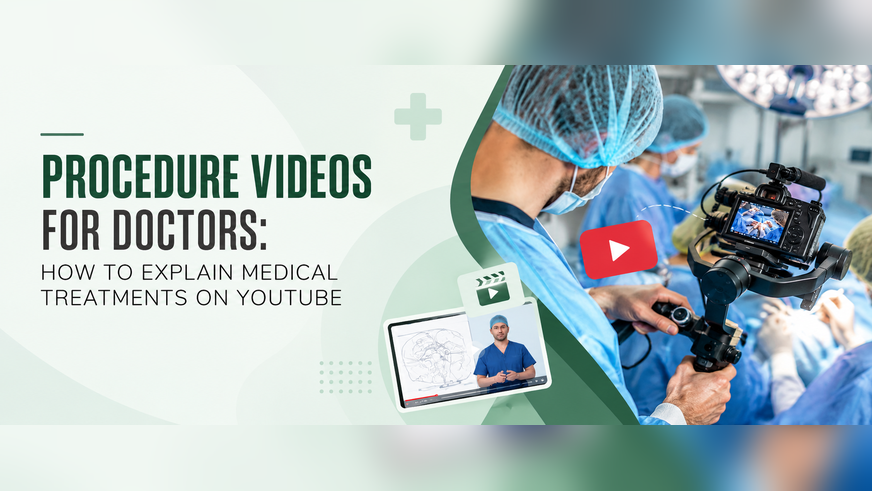
The moment a patient decides to seriously consider a medical procedure, one thing happens immediately: they search for a video. Not to verify credentials or compare clinic prices, but to understand what the experience actually involves. What will they see when they arrive? What will the doctor do? What will the procedure feel like? What will the next few days look like?
These are the questions driving some of the highest-intent healthcare searches on YouTube. And for most clinics in South Delhi and across India, this search finds nothing from the doctor the patient is already considering. It sends them instead to foreign clinics, generic medical channels, or, worse, content designed to generate fear rather than understanding.
Procedure videos are the category of healthcare YouTube content that most directly addresses this moment. When executed with clinical accuracy and patient-appropriate communication, they reduce anxiety, improve consultation readiness, and build the pre-visit trust that improves patient outcomes and clinic reputation simultaneously.
What You'll Learn
- What a procedure video is, and how it differs from a promotional video.
- Why patients research procedures on YouTube before booking a consultation.
- The six elements every medical procedure video should include.
- How to explain a procedure without overwhelming the patient.
- Video ideas for dermatology, hair transplant, dental, aesthetic medicine and ophthalmology.
- Common mistakes doctors make, and how to avoid them.
What Are Procedure Videos?
A procedure video is educational video content that walks a patient through a specific medical treatment or clinical process, from candidacy assessment through the procedure itself to recovery and results. It is not a surgical recording or a clinical demonstration for peers. It is an explanation, in accessible language and appropriate visual format, designed for a patient who is deciding whether a procedure is right for them.
Procedure video vs promotional video
The distinction between procedure video and promotional video is important and frequently misunderstood. A promotional video says "we perform excellent procedures at our clinic." A procedure video says "here is what this procedure involves, step by step, and here is what a realistic outcome looks like." One asks for trust. The other earns it.
Effective procedure videos are the single most powerful category of healthcare YouTube content for specialties where the patient's primary barrier is uncertainty rather than awareness. For hair transplant, aesthetic procedures, laser treatments, and most surgical specialties, uncertainty about the experience is what keeps patients from acting even when they are genuinely interested.
Why Patients Search for Procedure Information Before Treatment
Medical decision-making involves a specific kind of research behaviour that differs from almost every other consumer decision. When a patient is considering a hair transplant, they are not comparing features like a person buying electronics. They are managing anxiety. They are seeking reassurance that they will be safe, that the outcome is realistic, and that they have made the right choice in the doctor they are considering.
YouTube serves this research need uniquely well because video communicates confidence, clarity and manner, not just information. A patient watching a surgeon explain their procedure with calm specificity and genuine consideration for patient concerns is not just receiving information. They are evaluating trustworthiness in real time.
"A patient who has watched your procedure video arrives at the consultation with their decision 70% made. The consultation confirms what the video already communicated."
— Prince KhatanaThis pre-visit trust formation means that procedure video is not just a marketing asset. It is a clinical asset. Patients who arrive better informed have more productive consultations, set more realistic expectations, and tend to report higher satisfaction with outcomes, regardless of the clinical result itself.
What Should a Medical Procedure Video Include?
A well-constructed procedure video covers six essential elements, in a sequence designed to match the patient's emotional and informational journey through the content.
- Candidacy. Who is this procedure most suitable for? Setting this context early allows patients to self-qualify and ensures the audience most likely to benefit watches through.
- How the procedure works. A plain-language explanation of the mechanism, not a clinical description for colleagues. Use analogies where they help. Avoid assuming the patient has any prior medical knowledge.
- The preparation process. What happens before the procedure? What should the patient do in the days leading up to it? What should they avoid? This practical information significantly reduces pre-procedure anxiety.
- The procedure experience. What will the patient see, feel and experience on the day? How long does it take? What sensation is involved? Is there discomfort? Honest, specific answers to these questions build more trust than reassuring platitudes.
- Recovery and aftercare. What do the first 24 hours look like? The first week? When can the patient return to work? What results should they expect, and over what timeline? This is consistently the section patients value most and the section most procedure videos underserve.
- Realistic outcomes. What can genuinely be achieved? What determines whether a result is excellent versus adequate? A procedure video that addresses this honestly demonstrates the kind of clinical integrity that converts curious viewers into consultation bookings.
How to Explain a Procedure Without Overwhelming the Patient
One of the most common mistakes in healthcare video content is information overload. The instinct is understandable: the doctor knows a great deal about the procedure and wants the patient to be fully informed. But a patient absorbs very different amounts of information when they are watching a YouTube video at home versus sitting in a consultation room with a doctor present.
The principle to follow is depth over breadth. One procedure video should go deep on one aspect rather than attempting to cover everything. A series of focused videos (candidacy, the procedure day, recovery week one, long-term maintenance) is far more effective than a single comprehensive video that tries to address everything in twelve minutes.
Each video in the series also provides an additional opportunity for the patient to return to the channel, extending the familiarity-building process and deepening the relationship with the doctor before the consultation has happened.
Procedure Video Ideas for Key Healthcare Specialties
| Specialty | Procedure video ideas |
|---|---|
| Dermatology | PRP treatment walkthrough, chemical peel procedure day, laser hair removal session experience, hydrafacial process, mole removal procedure, acne scar treatment options. |
| Hair transplant | FUE procedure day timeline, graft extraction and placement explained, what to expect in the first week post-transplant, month-by-month hair growth results, hairline design consultation process. |
| Dental | Dental implant procedure from extraction to crown, root canal demystified, Invisalign tray fitting process, teeth whitening session walkthrough, gum graft procedure explained. |
| Aesthetic medicine | Botox injection process, dermal filler placement walkthrough, thread lift procedure, PRP facial treatment, chemical peel experience. |
| Ophthalmology | LASIK surgery day timeline, ICL implant procedure, cataract surgery from pre-op to discharge, how corneal mapping works before refractive surgery. |
Common Mistakes Doctors Make in Procedure Videos
- Using clinical terminology without a patient-accessible explanation. The video educates colleagues but leaves patients more confused than before.
- Showing only best-case outcomes. Without representing the range of realistic results, the video builds expectations that damage trust when outcomes differ.
- Recording at too low a production quality. Particularly audio, which signals standards that undermine the credibility the video is trying to build.
- Skipping the recovery section. It is consistently the most searched and most valued part of procedure information for patients.
- Ending with a hard sell. "Book now, limited slots available" breaks the educational tone and reminds the patient they are watching a promotional asset, not a genuine educational resource.
Procedure Video Marketing in South Delhi
South Delhi, covering areas including Greater Kailash, Saket, Lajpat Nagar, Green Park and Hauz Khas, has a high concentration of specialist clinics serving a patient population with significant digital sophistication and high health investment intent. Patients in this area regularly research procedures extensively before committing to a consultation, and YouTube is a primary research tool.
For clinics operating in South Delhi, procedure video content serves both a discovery function (appearing in searches from patients actively researching) and a credibility function, demonstrating the clinical depth of the practice in a format patients find reassuring. Clinics in competitive South Delhi specialty areas that invest in consistent procedure video production typically develop a distinctive digital advantage over those relying solely on Google Ads or social media promotion.
How Dr. Graphical™ Produces Healthcare Procedure Videos
Dr. Graphical™ approaches procedure video production as a communication design exercise rather than a filming exercise. Before a camera is switched on, we work with the doctor to map the patient's exact concerns at each stage of their decision journey, then structure the video to address those concerns in the sequence in which the patient experiences them.
Scripts are developed collaboratively. The doctor provides the clinical accuracy, and Dr. Graphical™ provides the patient-accessible communication architecture. Production takes place in our professional Delhi studio or on location at the clinic, depending on the content type. Post-production applies healthcare-specific editing standards: pacing that communicates calm authority, on-screen text that clarifies without cluttering, and thumbnails that signal educational value.
Frequently Asked Questions About Procedure Videos
Should procedure videos show the actual procedure or use animation?
For most healthcare audiences and purposes, a doctor explaining the procedure on camera, with supporting graphics where they help, outperforms either raw surgical footage or pure animation. Raw clinical footage can increase anxiety rather than reduce it. Pure animation lacks the personal connection that builds trust. The most effective format is the doctor speaking directly to camera, with illustrative graphics used selectively to clarify specific technical points.
How does a procedure video differ from a patient testimonial?
A procedure video explains the clinical process from the doctor's expert perspective. A patient testimonial shares the experience from the patient's subjective perspective. Both are valuable and serve different trust-building functions. The procedure video educates and reduces clinical uncertainty. The testimonial provides social proof and emotional reassurance. The strongest healthcare YouTube channels use both, as complementary rather than competing content types.
How often should a clinic update its procedure videos?
Procedure videos should be reviewed annually and updated when the clinical approach, equipment or best practice has meaningfully changed. Unlike blog content, video content is harder to update incrementally, so it is generally better to produce a new video than to edit an existing one. A growing library with regular additions is more effective than a small library of perpetually updated videos.
Do procedure videos work for all healthcare specialties?
Procedure video content is most impactful for specialties where a patient's primary barrier to booking is procedural uncertainty: aesthetic medicine, hair transplant, elective surgery, dental work and vision correction. It is less central for acute care or referral-based specialties where patient research behaviour follows a different pattern. Dr. Graphical™'s content planning process identifies the specific content types most relevant to each specialty before production begins.
Is patient consent required for procedure video content?
Any video content that includes identifiable patients, whether their appearance, voice or personal health information, requires explicit, documented patient consent that clearly explains how the content will be used, where it will be published and for how long. This is both an ethical requirement and a professional protection. Dr. Graphical™ provides consent framework guidance as part of our video production process.
About this article: This guide was produced by the Dr. Graphical™ content team based on healthcare video marketing experience, YouTube platform best practices, and publicly available industry research. Healthcare-related claims in any clinic's content should be reviewed by a qualified medical professional before publication.