YouTube SEO for Doctors and Clinics: A Complete Healthcare Channel Optimisation Guide
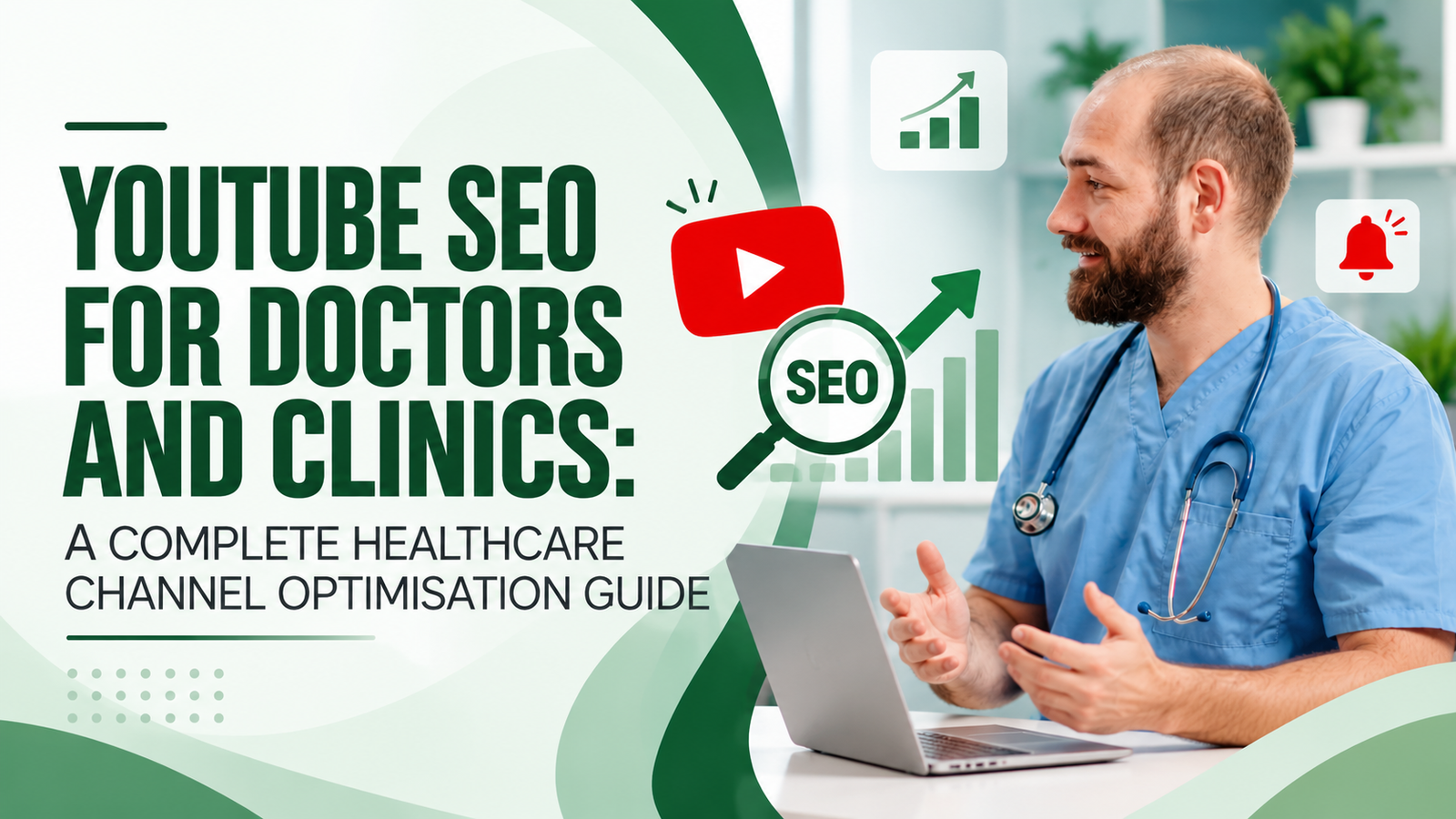
Most healthcare YouTube channels are invisible to the patients who need them. Not because the content is poor — often it is clinically excellent. But because the channel has not been optimised for the way YouTube's search and recommendation systems actually work. The videos exist, but they are not being found.
YouTube SEO for doctors is the discipline of ensuring that a healthcare channel's content surfaces in the searches patients are conducting, earns the algorithmic signals that expand reach beyond existing subscribers, and builds the cumulative channel authority that makes individual videos perform better over time.
This is not a technical specialty that requires a background in digital marketing. It is a set of principles and practices — most of them straightforward once understood — that any healthcare professional or their team can learn and apply consistently. This guide covers the complete framework, from keyword research through channel architecture, with specific attention to the healthcare context that makes medical YouTube SEO distinct from general video optimisation.
What You'll Learn
- What YouTube SEO is and how search ranking and recommendation systems work for healthcare channels.
- Why YouTube SEO matters specifically for doctors by creating a discovery-to-trust pathway before commercial interaction.
- How to conduct healthcare keyword research using patient language rather than clinical terminology.
- How to optimise video titles, descriptions, tags, and thumbnails to maximize click-through rates and search visibility.
- Channel architecture and playlist strategies that mirror the patient journey and build authority.
- Local YouTube SEO tactics for medical practices in high-footfall areas like Lajpat Nagar.
- Key metrics and common mistakes to avoid when managing a medical YouTube presence.
What Is YouTube SEO?
YouTube SEO is the practice of optimising video content and channel architecture so that YouTube's search algorithm surfaces relevant content to users searching for related topics. Like Google SEO, it involves understanding how the platform determines relevance, quality, and authority — and creating content that meets those criteria genuinely rather than trying to manipulate the algorithm through superficial tactics.
YouTube's algorithm makes two types of decisions that YouTube SEO influences: search ranking (where a video appears when a user searches a specific query) and recommendation (whether YouTube's system suggests the video to users who might find it relevant, even without searching). Both matter for healthcare channel growth, and they are influenced by overlapping but distinct sets of signals.
Why YouTube SEO Matters Specifically for Doctors
For healthcare professionals, YouTube SEO matters for reasons that go beyond channel growth metrics. When a patient searches "hair transplant recovery week one" or "what causes adult acne" and finds a doctor's educational video, something important happens: the patient's trust in that doctor — someone they may never have encountered before — begins forming before any commercial interaction. This discovery-to-trust pathway is entirely dependent on the video being findable.
A dermatologist who produces excellent awareness content that is not optimised for search may be helping the patients who already follow the channel. But they are invisible to the much larger population of patients who are searching for exactly the information the video contains and do not yet know this doctor exists. YouTube SEO is what makes expertise discoverable.
"The most useful healthcare video in the world does nothing for a patient who can't find it. YouTube SEO is how you make sure they can."
— Prince KhatanaKeyword Research for Healthcare YouTube Channels
Healthcare YouTube keyword research begins with the same fundamental question as all content strategy: what are the actual queries that patients type into YouTube when they are looking for information about the conditions and treatments in this specialty?
The most reliable sources for healthcare YouTube keyword data include:
- YouTube search autocomplete — type a condition, treatment, or concern into the YouTube search bar and observe what completions appear. These are real searches, suggested by YouTube based on actual query volume.
- Google "People Also Ask" results for healthcare queries — the questions Google surfaces in this feature represent high-volume informational searches that translate well to video content.
- Comment sections on existing healthcare YouTube videos in the specialty — patient questions in comments reveal real information gaps and genuine search intent.
- Consultation intake data — the questions patients write down before they meet the doctor are the same questions they are typing into YouTube.
- Google Search Console data from the clinic's website — the search queries driving organic traffic to the clinic site often map directly to high-value YouTube topics.
For healthcare content, patient language consistently outperforms clinical language. A video titled "FUE vs FUT: Follicular Unit Extraction and Follicular Unit Transplantation Compared" will underperform a video titled "Stitch vs No-Stitch Hair Transplant: Which Is Right for You?" — not because the first is less accurate, but because patients do not search with clinical terminology.
Optimising YouTube Video Titles for Healthcare Search
The video title is the most important single on-page SEO element for a YouTube video. It is the primary signal YouTube's algorithm uses to understand a video's topic, and it is the primary element a viewer uses to decide whether to click.
Effective healthcare video titles for YouTube SEO follow three principles:
- Lead with the patient's question or concern. Titles that mirror the patient's actual search query perform better than titles that describe the video's content from the doctor's perspective. "Is PRP Worth It for Hair Loss? What I Tell My Patients" outperforms "PRP for Androgenetic Alopecia: Clinical Considerations."
- Include the primary keyword naturally. The keyword should appear in the first half of the title where possible. YouTube truncates long titles in search results, so the most important information must appear early.
- Avoid clickbait at the expense of accuracy. Healthcare content that overpromises in the title and underdelivers in the content is penalised by YouTube through poor retention signals. The title should accurately represent what the video contains — the goal is the right viewer watching to the end, not maximum clicks from viewers who leave immediately.
Writing Better YouTube Descriptions for Healthcare Channels
YouTube video descriptions serve two audiences simultaneously: YouTube's algorithm, which uses description text to understand the video's relevance to specific searches, and viewers, who often check descriptions for additional resources, links, or specific information mentioned in the video.
An effective healthcare YouTube description structure:
- Opening paragraph (first 200 characters, visible before "show more"): a clear, engaging summary of the video's content using natural language that includes the primary keyword.
- Extended summary: 150 to 250 words expanding on the topics covered, using secondary keywords naturally in the context of genuine content description.
- Timestamps: chapter markers for videos over five minutes, using descriptive section titles that contain relevant keywords.
- Related resources: links to relevant videos on the channel, the clinic's website pages, and the consultation booking page.
- About the doctor: two to three sentences about the practitioner, their specialty, and the clinic — establishing the authorship credential that reinforces the E-E-A-T signals YouTube and Google evaluate for healthcare content.
YouTube Tags and What Actually Matters
Tags remain a minor but non-trivial YouTube SEO element. Their influence on ranking is significantly smaller than titles, descriptions, and engagement signals — but they provide useful context signals, particularly for multi-word phrases and spelling variants.
Effective tag strategy for healthcare YouTube videos: include the primary keyword, two to three semantic variants, the specialty category, the location where locally relevant, and the doctor's name and clinic name for branded searches. Avoid tag stuffing with excessive irrelevant terms — YouTube's algorithm has become sophisticated at detecting this practice and it no longer provides the benefit it once appeared to.
Thumbnail Strategy for Healthcare YouTube Channels
YouTube thumbnail click-through rate (CTR) is one of the strongest signals YouTube's algorithm uses to evaluate a video's performance in search. A compelling thumbnail that earns clicks from relevant searchers directly improves a video's search ranking, because high CTR signals that the thumbnail and title accurately match what searchers are looking for.
Healthcare thumbnail design should follow the opposite principle from most YouTube thumbnail conventions. Exaggerated facial expressions, excessive text, and high-contrast sensationalism work for entertainment content but undermine the professional credibility that healthcare audiences are evaluating. The most effective medical YouTube thumbnails communicate calm authority: a clear, direct image of the doctor, a specific brief text element that extends the title's promise, and a clean background that reflects the clinic's professional standards.
Channel Architecture: Playlists and Topic Clusters
YouTube channel architecture — how content is organised into playlists, series, and topic groups — significantly influences both viewer experience and algorithm signals. A well-organised channel tells YouTube clearly what topics the channel covers, which videos belong together, and what the channel's overall expertise focus is.
For healthcare channels, the most effective playlist structure mirrors the specialty's patient journey: an awareness and education playlist, a conditions and causes playlist, a treatments and procedures playlist, a Q&A playlist, and a patient stories playlist. This organisation allows viewers to navigate the channel's full educational library coherently and gives YouTube clear topical clustering signals that improve recommendation performance.
Local YouTube SEO for Delhi Healthcare Channels
For clinics serving specific Delhi areas, local relevance signals in YouTube content can improve both YouTube search rankings for location-modified queries ("dermatologist YouTube Delhi," "hair transplant videos West Delhi") and the video's contribution to the clinic's broader local search presence.
Local relevance can be incorporated naturally: the About section should clearly state the clinic's location, videos serving local patient communities can reference the area context authentically rather than mechanically, and the channel should link bidirectionally with the clinic's Google Business Profile and website — creating the entity connection that reinforces local search authority.
Measuring YouTube SEO Performance for Healthcare Channels
- YouTube Studio analytics: impressions, click-through rate, and average view duration are the three most important metrics for evaluating YouTube SEO performance. Impressions measure reach; CTR measures relevance and thumbnail effectiveness; average view duration measures content quality.
- YouTube Search report: shows the specific search queries that are surfacing videos in YouTube search — the most direct measure of keyword strategy effectiveness.
- External traffic report: shows how much traffic is arriving from Google search — the crossover benefit of YouTube SEO for the clinic's broader web presence.
- Subscriber growth from individual videos: identifies which content types are most effectively converting viewers into subscribers — the audience building metric that compounds channel authority over time.
Common YouTube SEO Mistakes for Healthcare Channels
- Optimising for clinical keyword terminology rather than patient search language
- Using identical or near-identical titles and descriptions across multiple videos covering related topics
- Publishing videos without timestamps in descriptions — missed opportunity for both user experience and search indexing
- Neglecting the first 48 hours after publication — YouTube's algorithm gives particular weight to early engagement signals, making the publication timing and initial promotion of healthcare videos strategically important
- Not cross-linking the YouTube channel from the clinic website and Google Business Profile — missed entity connection that weakens local SEO signals
- Treating YouTube SEO as a one-time setup rather than a continuous process — the most successful healthcare YouTube channels review and refine their optimisation approach quarterly
How Dr. Graphical™ Approaches YouTube Channel SEO
Dr. Graphical™'s YouTube SEO work for healthcare clients begins with a complete channel audit: evaluating existing content performance, identifying optimisation gaps in titles, descriptions, and thumbnails, and mapping the channel's current topical coverage against the full spectrum of patient search intent in the specialty.
Ongoing SEO management involves monthly performance reviews, quarterly content strategy adjustments based on search data, and systematic optimisation of new content before publication. The objective is not to rank for a single keyword but to build cumulative channel authority — the kind that makes individual videos perform better over time because they belong to a channel that YouTube's algorithm recognises as a credible, consistent, and relevant healthcare resource.
Frequently Asked Questions About YouTube SEO for Doctors
How long does YouTube SEO take to produce results?
YouTube SEO results develop over a different timeline than Google SEO. A well-optimised video typically shows its initial search performance within two to four weeks of publication, as YouTube's indexing and early engagement signals establish its relevance for target queries. Channel-level authority, which improves the baseline performance of all new content, builds meaningfully over three to six months of consistent, optimised publishing. Healthcare channels that maintain consistent quality and optimisation standards typically see compounding growth begin to accelerate noticeably after the six-month mark.
Does buying YouTube views or subscribers help with SEO?
No — and it carries significant risk. YouTube's systems are effective at detecting inauthentic engagement and will suppress or demonetise channels found to have manipulated metrics. More importantly, artificial engagement does not generate the retention signals that actually drive YouTube SEO performance. A video with 10,000 bought views and 20 percent average view duration will rank significantly worse than a video with 500 genuine views and 70 percent average view duration. The only metric that genuinely matters is authentic audience engagement.
Should healthcare videos be monetised?
Healthcare channels that meet YouTube's Partner Programme thresholds can monetise, but should consider the implications carefully. YouTube places ads on monetised videos without the creator's approval of specific advertisers — which means competitor clinics or inappropriate products could appear on a doctor's professional content. Many healthcare channels choose not to monetise their content in order to maintain complete control over the viewing experience and the professional integrity of their channel.
How does YouTube SEO relate to Google SEO for a clinic?
YouTube SEO and Google SEO are increasingly interconnected. YouTube videos appear in Google search results for relevant queries, and a clinic's YouTube channel is part of the entity signal that informs Google's understanding of the clinic's digital footprint. Strong YouTube SEO performance contributes to the clinic's overall Google authority, particularly for video-rich queries where Google surfaces YouTube content prominently. The two strategies are most effective when planned together rather than in isolation.
What is the most important YouTube SEO factor for a new healthcare channel?
For a new channel with no established authority, the most important factor is viewer retention — the percentage of each video that viewers actually watch. YouTube's algorithm learns from retention data faster than almost any other signal: a channel whose first ten videos each achieve 65 to 70 percent average view duration will develop algorithmic authority significantly faster than one whose videos are optimised but retain viewers poorly. Content quality that genuinely serves the viewer is the foundation that makes every other optimisation element work.
About this article: This guide was produced by the Dr. Graphical™ content team based on healthcare video marketing experience, YouTube platform best practices, and publicly available industry research. Healthcare-related claims in any clinic's content should be reviewed by a qualified medical professional before publication.